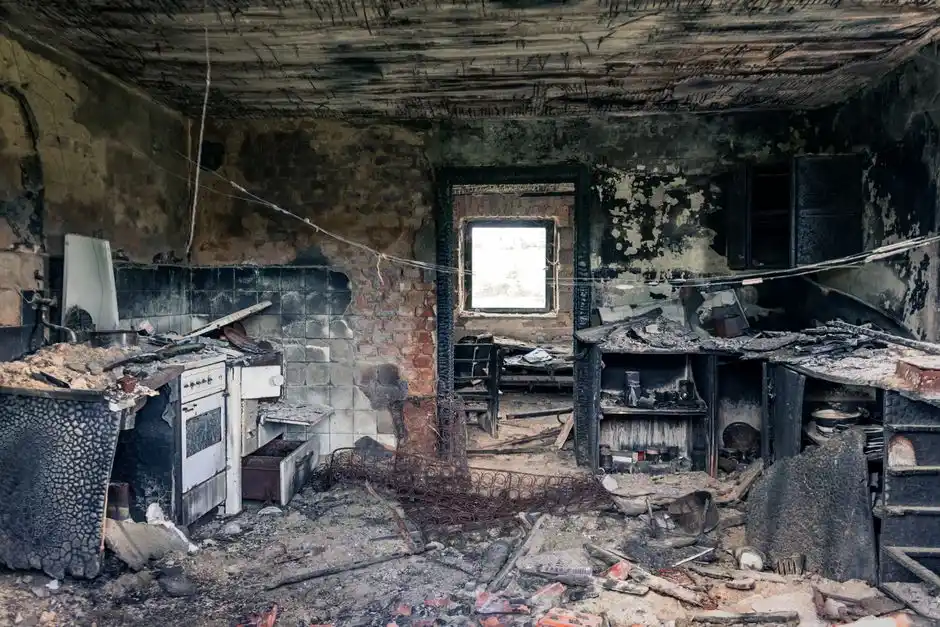
Soot keeps appearing on walls after fire damage because the smoke residue was never fully removed from the porous surfaces it soaked into. Drywall paper, textured paint, and unsealed wood act like sponges for carbon particles and oily smoke byproducts. When humidity rises or temperatures swing, those trapped particles bleed back through the surface and show up as fresh black smudges.
We see this constantly in PINON HILLS, where dry desert air and older housing stock create the perfect conditions for soot to resurface weeks or even months after a fire. This article explains exactly why soot returns, what surfaces hold it longest, and how to stop the cycle for good.
Why soot keeps reappearing on walls after a fire
Soot reappears on walls after a fire because incomplete combustion produces two very different residues: dry carbon powder and sticky oil-based smoke. The dry powder wipes away easily. The oily residue does not. It bonds to paint, soaks into drywall paper, and settles into every microscopic crack and texture ridge.
What causes soot to keep appearing on walls after fire damage in PINON HILLS California is almost always one of three things: residue left in porous materials, residue pulled back out by moisture, or residue spread by HVAC systems that were never cleaned. Once you understand which one you are dealing with, the fix becomes obvious.
Here is what happens at the molecular level. Smoke particles range from 0.1 to 4 microns in size. That is small enough to penetrate drywall paper, unsealed grout, and raw lumber. Standard cleaning removes what sits on the surface. It does nothing for what has already soaked in. Every time relative humidity climbs above 55 percent, those trapped particles wick toward the surface. You wipe the wall. Two weeks later, the smudge is back.
This is why soot removal in PINON HILLS is not a one-pass job. It requires sealing or encapsulating porous materials after cleaning, not just wiping them down.
The real culprits behind recurring soot
The most common reason soot keeps coming back is that the original cleanup stopped at the surface. Here are the specific culprits we find in homes and businesses across the High Desert.
Porous surfaces that were never sealed
Drywall, ceiling texture, brick, concrete block, and unfinished wood all absorb smoke residue. If your cleanup crew wiped these surfaces but did not apply a stain-blocking primer or encapsulant, the residue is still in there. It will bleed through paint within 30 to 90 days.
HVAC systems that were never cleaned
Your furnace and air conditioner pull smoke through every duct, coil, and filter housing in the system. If the HVAC was not professionally cleaned after the fire, every time you run the heat or AC, it blows microscopic soot particles back onto your walls. This is one of the most overlooked causes of soot reappearing after fire damage in PINON HILLS. We see it in roughly 4 out of 5 homes where the homeowner tried to handle cleanup themselves.
Incomplete cleaning of ceiling and upper walls
Heat rises. So does smoke. The ceiling and the top two feet of every wall carry the heaviest residue load. Many DIY cleanups focus on eye-level surfaces and miss the ceiling entirely. Soot on the ceiling then drips or gets redistributed by air currents.
Residue in carpet, drapes, and upholstery
Soft materials hold smoke odor and particles. Every time someone walks on the carpet or sits on the couch, particles become airborne again and settle on walls. If the soft goods were not cleaned or removed, they will keep feeding the problem.
Moisture and humidity swings
PINON HILLS sits at about 4,000 feet elevation. Summer days can hit 95°F and drop to 55°F at night. That swing pulls moisture in and out of building materials. Each cycle draws more trapped residue to the surface. This is why soot keeps coming back in PINON HILLS California long after the fire is out.
How to stop soot from coming back
Stopping soot from reappearing requires removing the source, not just cleaning the visible stain. Here is the sequence that works.
- Test the residue type. Dry soot (from fast-burning fires) vacuums up. Wet, oily soot (from slow-burning, smoldering fires) requires a chemical degreaser. Using the wrong method smears the residue deeper.
- Clean from the top down. Start at the ceiling, work down the walls, and finish with floors. This prevents dirty water from dripping onto already-clean surfaces.
- Use the right chemistry. Alkaline cleaners break down oily residue. Solvent-based cleaners cut through synthetic smoke from plastics and foam. One product does not fit every fire.
- Seal every porous surface. After cleaning, apply a shellac-based or oil-based stain-blocking primer. This locks any remaining residue in place so it cannot wick back out.
- Clean the HVAC system. Replace all filters, clean the blower and coils, and have the ducts professionally cleaned. If you skip this step, soot will return within weeks.
- Remove or clean soft goods. Carpet, drapes, and upholstery either get professionally cleaned or get removed. There is no middle ground.
If you want to know how to clean soot off walls in PINON HILLS without making it worse, start with a dry chemical sponge on a small test patch. If the sponge comes away black, you have dry soot. If it smears, you have oily residue and need a degreaser. Never use water alone on oily soot. It spreads the stain.
For anything beyond a small, contained fire, professional soot cleanup in PINON HILLS is faster and more thorough than DIY. Our team uses HEPA vacuums, chemical sponges, and commercial-grade encapsulants that you cannot buy at a hardware store.
Common mistakes that make soot worse
The biggest mistake we see is painting over soot without sealing it first. Paint alone does not block smoke residue. Within a few months, the stain bleeds through the new paint and you are back to square one - except now you have to strip the paint too.
Other mistakes that cause soot to keep appearing on walls after fire damage:
- Using a standard vacuum instead of a HEPA vacuum. Standard vacuums blow fine particles back into the air.
- Wiping walls with a wet rag before dry-vacuuming. This pushes oily residue deeper into the drywall.
- Skipping the ceiling. Soot on the ceiling redistributes every time the HVAC runs.
- Running the furnace or AC before the ducts are cleaned. This spreads soot through the entire house.
- Using bleach on smoke residue. Bleach does not break down oils. It just bleaches the color and leaves the residue behind.
- Cleaning only the room where the fire happened. Smoke travels through the whole structure, especially in open floor plans.
One more thing: do not assume the soot is gone just because the wall looks clean. Soot residue is often invisible until humidity pulls it to the surface. A $15 smoke residue test kit from a hardware store can tell you whether the wall is actually clean or just hiding the problem.
When to call a professional
Call a professional when the fire involved any synthetic materials (plastics, foam, electronics), when the HVAC system was running during or after the fire, or when soot has already reappeared after a DIY cleanup attempt. Those three scenarios almost always require commercial equipment and encapsulation.
We handle soot cleanup after fire in PINON HILLS for homeowners, landlords, and business owners. Our process includes HEPA vacuuming, chemical sponge treatment, thermal fogging for odor, HVAC cleaning, and stain-blocking primer on every porous surface. We do not just clean the visible soot. We eliminate the source so it cannot come back.
If you are dealing with a fire that also involved water from sprinklers or firefighting efforts, you may need fire and flood restoration in PINON HILLS to address both damage types at once. Water and soot together create a much bigger problem than either one alone.
Frequently Asked Questions
What causes soot to keep appearing on walls after fire damage in PINON HILLS?
Soot reappears when smoke residue was left in porous materials like drywall, texture, and wood. Humidity pulls it back to the surface. HVAC systems that were not cleaned also blow particles back onto walls every time they run.
How do I stop soot from coming back in PINON HILLS California?
Clean all surfaces from the ceiling down, seal every porous material with a stain-blocking primer, and have your HVAC system professionally cleaned. Skipping any of these three steps almost guarantees the soot will return within 30 to 90 days.
How do I clean soot off walls in PINON HILLS?
Start with a dry chemical sponge to test the residue type. For dry soot, use a HEPA vacuum. For oily soot, use an alkaline degreaser, then seal the surface. Never use water alone - it spreads oily residue deeper into the wall.
Who can remove soot in PINON HILLS?
Fire Damage Restoration Pinon Hills removes soot from walls, ceilings, HVAC systems, and soft goods. We use HEPA equipment, commercial encapsulants, and thermal fogging to eliminate soot at the source, not just the surface.
How long does professional soot removal take?
A single-room fire typically takes 1 to 3 days for full soot removal and sealing. Whole-house jobs with HVAC contamination take 5 to 10 days. The sealing step adds 24 to 48 hours of dry time before painting.
Get help with Fire Damage Restoration in PINON HILLS
If soot keeps coming back after your fire, the residue is still in your walls, your ceilings, or your HVAC system. We find it, remove it, and seal every surface so it cannot return. Call Fire Damage Restoration Pinon Hills at (833) 929-6186 for a same-day inspection.